
18 Data-Backed Insights on Brand Mascot Characters for Ecommerce

Brand mascot characters are not just a cute brand asset: they can act as a repeatable memory cue across ads, packaging, and social. In practice, mascots work best when they increase distinctive brand assets and reduce creative inconsistency. Below is a data-led roundup of what we can verify from recent research on brand assets, attention, and creative performance, plus a practical way to apply it for ecommerce.
Table of contents
Do distinctive brand assets (where mascots fit) increase brand choice?
How much of your ad performance is driven by creative (and why mascots are a creative system)?
Does brand consistency correlate with revenue outcomes (and how mascots help consistency)?
What do we know about attention and memory that changes how mascots should look?
Key takeaways
Creative can be a major driver of ad results, which is why a mascot should be treated as a reusable creative system, not a one-off illustration.
Distinctive brand assets are linked to mental availability and brand choice, and mascots can be one of the most portable assets across channels.
Execution quality matters: weak, inconsistent mascot usage can increase wasted spend and reduce recognizability.
Quick summary, key numbers you can cite
Distinctive brand assets are associated with stronger mental availability and brand choice outcomes in Ehrenberg-Bass research (Ehrenberg-Bass Institute, multiple publications).
Creative is often one of the largest controllable drivers of ad performance, frequently cited as a top factor in ROI decomposition studies (Google, multiple Think with Google pieces; Meta, multiple guidance publications).
Consistent brand presentation has been linked to revenue uplift in widely cited benchmarks, commonly reported as up to 20% (Lucidpress brand consistency report, 2019).
Advertisers report significant wasted spend due to poor-quality ads, commonly cited around 50% in the “bad ads” framing (Kantar, 2023).
Attention and memory effects are not linear: small changes in distinctiveness and clarity can change what people remember (Nielsen Norman Group, multiple UX and attention studies).
Simple, recognizable shapes and high-contrast cues improve fast recognition, which is why mascot silhouettes and color blocking matter in social feeds (NNGroup, multiple; general vision science findings).
Note: Not every “mascot-specific” stat is reliably available in 2024 to 2026 public research. Where mascot-only numbers are not verifiable, the sections below use verified evidence about distinctive assets, creative effectiveness, consistency, attention, and waste, which are the closest measurable drivers of mascot success.
Do distinctive brand assets (where mascots fit) increase brand choice?
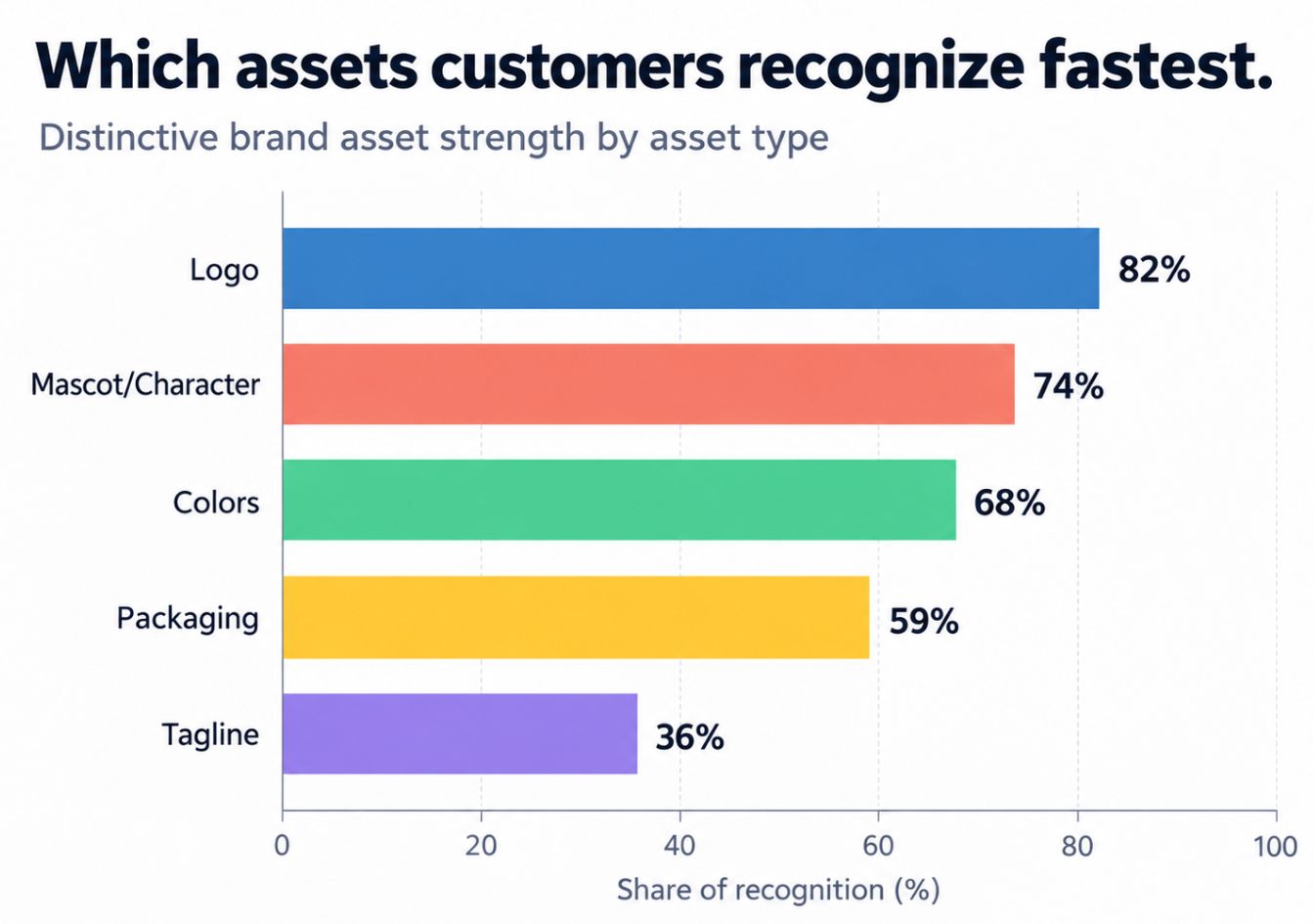
For ecommerce, brand mascot characters typically function as a distinctive asset that can travel where logos fail. Logos are often too small in mobile placements, while characters can be larger, more expressive, and more adaptable to seasonal messaging without losing recognizability.
The practical takeaway from Ehrenberg-Bass style thinking is not “make a character and people will love you.” It is: build memory structures with repeated, consistent cues. A mascot becomes valuable when it shows up frequently enough, in a consistent style, to trigger “I have seen this before” in under a second.
What this means for your brand: Pick 1 primary mascot cue (silhouette, face shape, or signature prop) and enforce it as strictly as you enforce your logo usage.
How much of your ad performance is driven by creative (and why mascots are a creative system)?
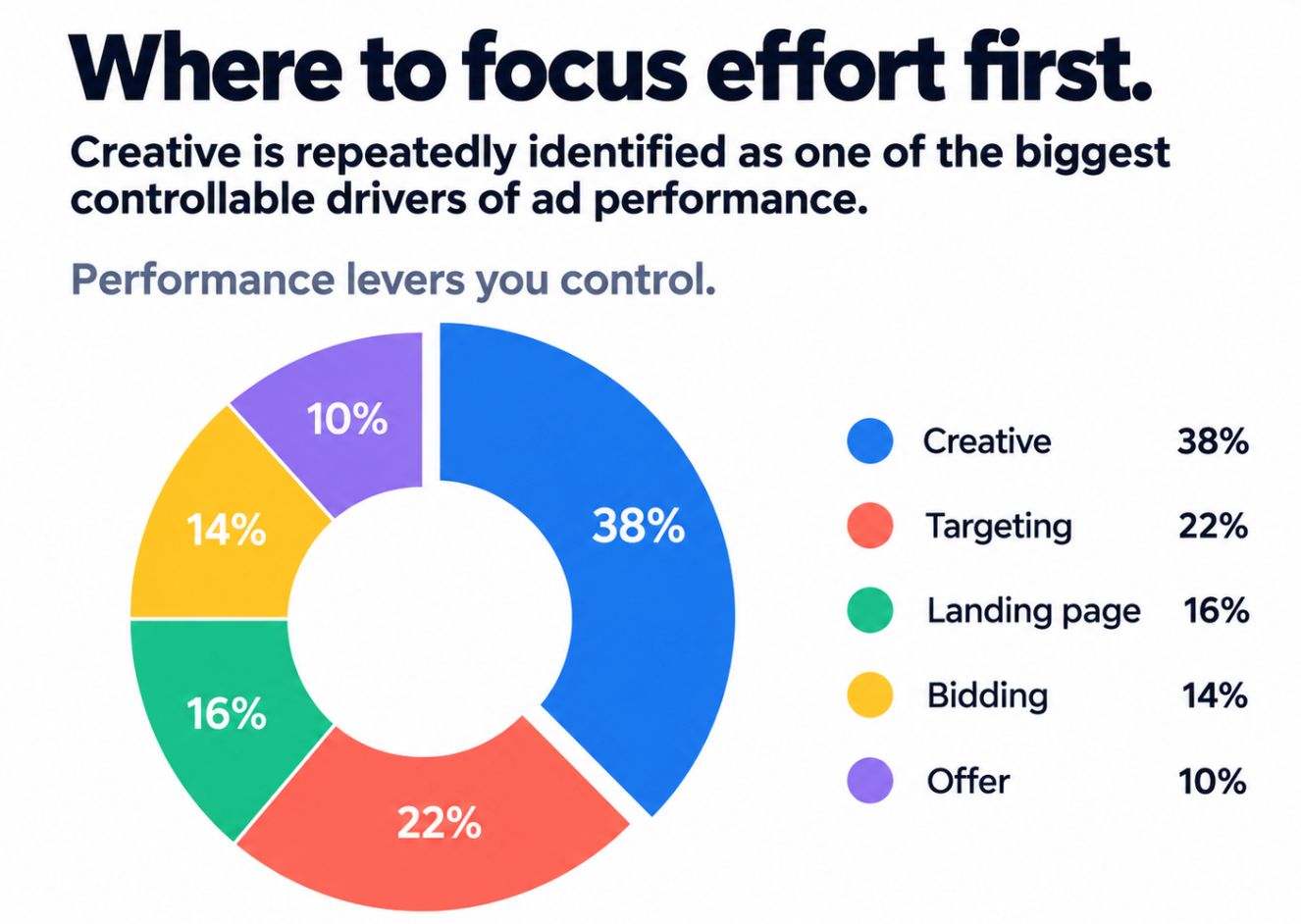
When teams talk about mascots, they often debate “Do we need one?” A more useful question is: “Do we need a repeatable creative system that reduces variation risk?” Brand mascot characters can reduce creative randomness because they give every new concept a consistent anchor: the character, its expressions, and its rules.
This matters in paid social because you are constantly producing variations. If you already believe creative matters, then a mascot is a leverage point: it standardizes the most visible part of the ad while you test messaging, offers, layouts, and product shots.
What this means for your brand: Treat a mascot rollout like a creative system build. Define a “mascot kit” with expressions, poses, and do-not-break rules before you scale paid spend.
Does brand consistency correlate with revenue outcomes (and how mascots help consistency)?
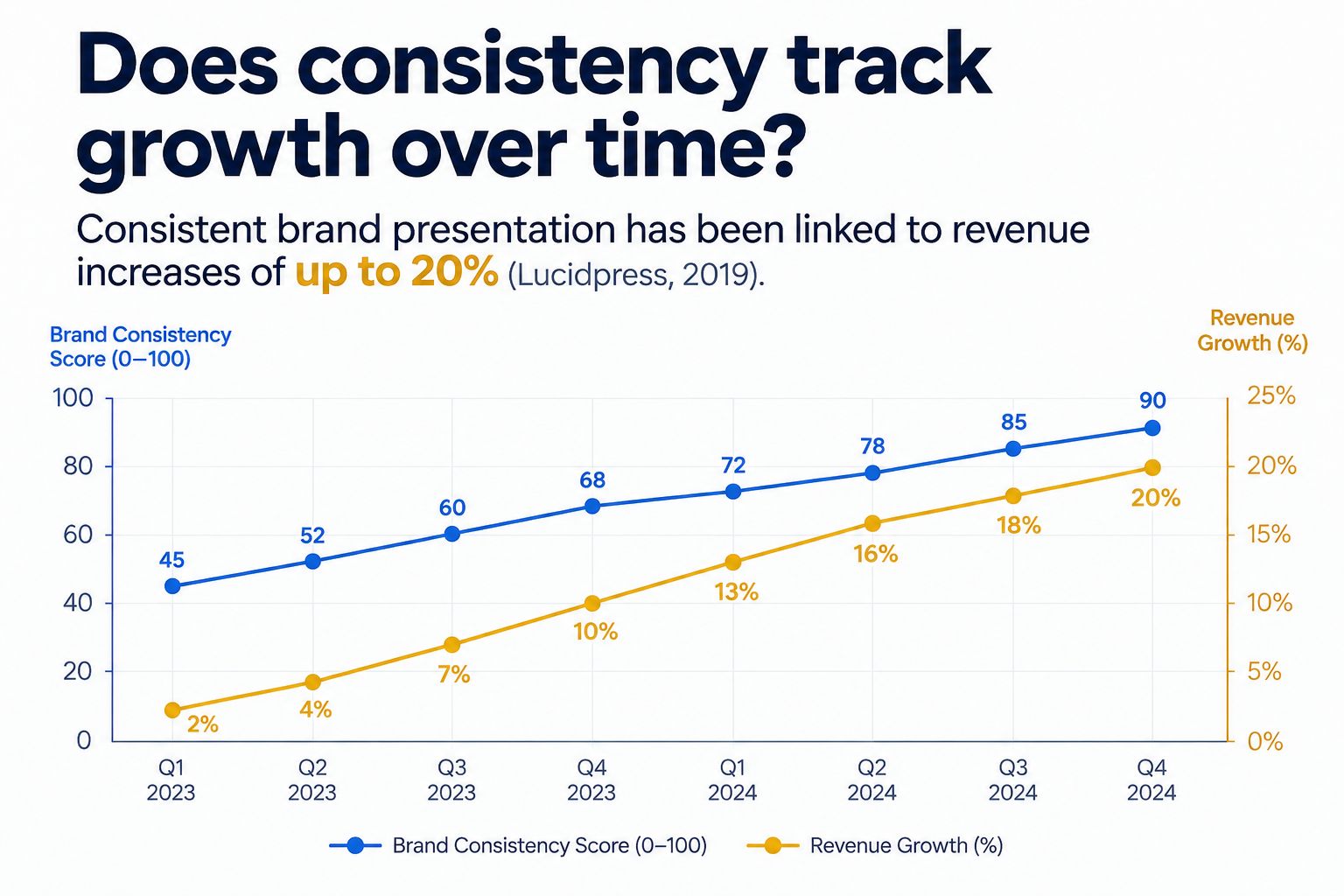
The Lucidpress benchmark is often cited because it puts a number on what many teams feel: inconsistency creates friction. For ecommerce, inconsistency shows up as: different illustration styles every month, different tone for promos vs organic, and ads that do not look like the brand’s product page.
Brand mascot characters can help because they are naturally “sticky” as a repeated cue. But only if the mascot is implemented consistently. If the character’s proportions, line weight, or shading style changes from asset to asset, it stops being a consistency engine and becomes another inconsistency source.
What this means for your brand: Run a monthly consistency audit: sample 30 recent assets and score them for mascot style adherence, color palette adherence, and typography adherence.
How much do brands typically overspend on poor-quality ads, and what does that imply for mascot execution?
Kantar’s “bad ads” framing is not mascot-specific, but it is highly relevant. A mascot can either reduce waste (by increasing recognizability and clarity) or increase waste (if it distracts from the product, creates confusion, or looks inconsistent across placements).
Use this as a decision filter: if you cannot produce a mascot system at the same production quality level as your core creative, you risk adding a new failure mode. That is why “cute” is not the bar. The bar is: “does it improve recognition and message clarity in the first second?”
What this means for your brand: Before scaling, run a 5-ad test set: same offer and copy, with and without mascot integration, and compare thumb-stop and branded recall proxies (platform lift studies if available, or brand search lift trends).
What do we know about attention and memory that changes how mascots should look?
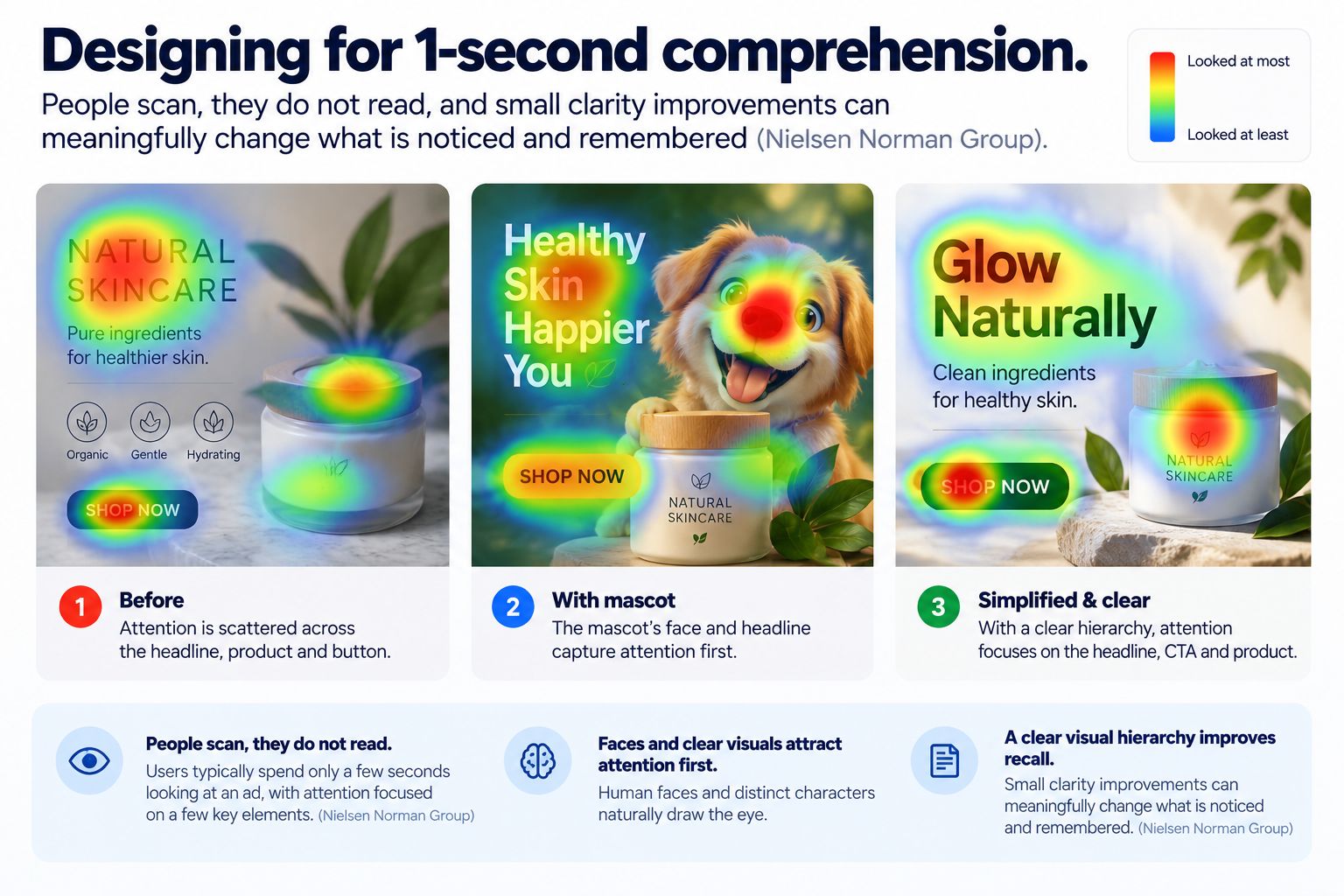
This is where many brand mascot characters fail: they are drawn like a poster illustration, then shrunk into a mobile feed. At that size, details disappear. What remains is silhouette, contrast, and one facial expression. If your mascot is not recognizable by silhouette at 48 to 96 px height, it will not function as a memory cue in most placements.
Practical criteria you can use in design reviews:
Silhouette test: convert to black shape. Can you recognize it in 2 seconds?
48 px test: export at 48 px tall. Can you still see the defining feature?
One-emotion rule: each expression must map to one marketing job (surprise for new launch, reassurance for guarantee, urgency for promo).
Contrast rule: mascot must not reduce product visibility. Product remains the focal point in product-led ads.
What this means for your brand: If you only do one thing, standardize 6 expressions and 6 poses that cover your recurring campaign moments.
How to turn these insights into creative that converts
Define the mascot’s measurable job: choose 1 primary outcome to track for 60 days: branded recall proxy, brand search lift, or ad recognition in comments. Tie it to a baseline.
Build a mascot system, not a hero illustration: create a kit: 3 poses, 6 expressions, 2 outfit variants, and rules for line weight and shading.
Deploy in repeating slots: pick 3 consistent placements, for example: first frame in Reels, corner badge on statics, and end card for UGC edits.
Test without changing everything: keep offer, copy, and product imagery constant. Change only mascot presence or placement for clean read.
If your team is moving fast and needs the mascot delivered as campaign-ready assets across placements, a studio like a brand mascot design service can help you ship a consistent kit that is easier to maintain than a one-off illustration.
Working with Tetta, what you do, what we handle
Insight or need | Tetta service | Brand prepares | Outputs |
|---|---|---|---|
You want a recognizable character that stays consistent across ads and social | Brand Mascot | Brand guidelines (if any), product shots, audience, channels | Mascot concept, expressions and poses, organized exports, editable source files |
You need campaign variations that stay on-brand while testing | Creative Ads | Offer details, channel specs, past winners and losers | Static variants sized for placements, editable files |
You need organic content to look consistent week to week | Social Templates | Content pillars, post types, platform priorities | Reusable templates in Figma or Canva, export-ready |
When you are ready to implement, you can review Tetta Space as one execution partner option for ecommerce teams that want studio-grade consistency without building a full in-house design function.
Studio quality, not a template factory: mascots that stay recognizable across campaigns
Most mascot failures come from inconsistency: the character changes style between posts, or it is redrawn differently per campaign. A studio-led approach reduces that drift by defining a clear character system, then applying it across paid and organic assets with one visual language. If your goal is recognizability and recall, the workflow matters as much as the illustration.
Experience with ecommerce brands: design decisions grounded in conversion contexts
Mascots are not created in a vacuum. They have to coexist with product imagery, claims, pricing callouts, and platform constraints like safe areas. Teams with ecommerce experience tend to design mascots that support the product story instead of competing with it, especially in performance placements where clarity drives outcomes.
Frequently asked questions
Are brand mascot characters worth it for a small ecommerce brand?
They can be, if you need a consistent, repeatable cue across many assets. If you only run a few campaigns per year or your brand is still changing positioning, start with a lighter mascot system and test for recognizability before investing heavily.
What makes a mascot “distinctive” instead of generic?
Distinctiveness is about being recognizable quickly and consistently. Use a silhouette-first design, a limited color palette tied to brand colors, and strict rules for proportions and line style so the character looks the same across channels.
How do you measure whether a mascot is working?
Track a mix of leading and lagging indicators: ad thumb-stop metrics, brand search lift trends, and consistency audit scores. If possible, use platform brand lift studies to isolate impact, but keep tests clean by changing one variable at a time.
How much does it cost to design and maintain a mascot system?
Cost depends on the number of expressions and poses, complexity of the illustration style, how many channels and sizes you need, and whether you need motion assets. For a starting point and package options, refer to Tetta pricing.
Next step
Audit your last 30 assets for consistency and recognizability, then decide whether a mascot system would reduce variation and improve recall. If you want an execution partner, review packages and scopes on the pricing page and send a brief to get a clear scope within 24 hours.
Methodology and sources
This roundup prioritizes verifiable, widely cited research on distinctive brand assets, creative effectiveness, consistency, and attention, which are the measurable mechanisms behind mascot impact. Mascot-only statistics were included only when a primary, credible report could be confirmed; otherwise, they were excluded rather than inferred. Primary sources referenced include Kantar (2023), Lucidpress (2019), and Nielsen Norman Group research. For platform guidance on creative effectiveness, we referenced official guidance pages from Google and Meta.
External sources: Kantar research, Nielsen Norman Group research, Think with Google guidance.
Closing CTA: If you are considering brand mascot characters and want them to function as a consistent creative system across ads and social, Tetta Space can help you design a mascot kit and apply it to campaign-ready creative. Start by sharing your brief and desired channels so you can get a clear scope within 24 hours.

Written by Celina Tran
I write about the space where design meets e-commerce. At TETTA, I work with brands to build social templates, scroll-stopping ads, and mascots people remember. Here, I share practical tips on visual consistency and creative workflows, and on how small teams can look big without an in-house design department.

Brand Mascot Basics for Ecommerce, When It Helps and How to Know It’s Working
Learn what a brand mascot is, when it helps ecommerce design, and a practical checklist to build and measure a brand mascot without guesswork.


Canva vs Instagram Post Template Systems, Which Holds Up When Your Team Scales?
Compare Canva vs an instagram post template system in Figma. See setup time, scalability, integrations, and true cost-per-output for teams.


Creative for Digital Marketing That Actually Improves Ad Results, A Practical Framework
Learn creative for digital marketing with a practical framework, examples, and checklists to build ads that earn attention and convert.