
Creative Facebook Ads vs Traditional Product Shoots: Which Fits Lean E-commerce Teams?

If your Meta spend is stable but performance is volatile, the bottleneck is often creative output. This comparison looks at creative facebook ads (design-led, iterative ad production) versus traditional product shoots (photo-first production) so you can choose the fastest, most scalable way to ship new angles without breaking brand consistency.
Table of contents
Key takeaways
Choose design-led creative facebook ads when you need more variations per week and faster time-to-first-launch.
Choose product shoots when you truly need new photography (new SKUs, texture-critical products, or strict retail requirements).
Evaluate “cost-per-output” (usable ad variations shipped) rather than day rates or per-asset pricing.
The State of the Market: Iteration Beats Perfection
Direct answer (50 words): Creative-first production optimizes for speed and volume of ad variations, while traditional product shoots optimize for photographic realism and hero assets. Shoots are still common, but the market is shifting toward AI-assisted, self-serve creative iteration so teams can test more angles weekly without scheduling and reshoots.
What changed is not that photography stopped mattering; it is that most performance gains come from message, offer framing, and variation, not from a single “final” image. Meta itself has long emphasized creative as a primary driver of performance in auction-based delivery. See Meta’s ads guidance for current best practices and formats.
Head-to-Head Comparison Table
Criteria | Creative Facebook Ads (Design-led, iterative) | Traditional Product Shoots (Photo-led, scheduled) |
|---|---|---|
Setup Time | Often same day if you have brand assets, product angles, and offer details ready | Commonly days to weeks (brief, talent/props, studio time, editing, approvals) |
Learning Curve | Low to medium: requires a repeatable creative system (templates, format rules, brand constraints) | Medium: requires production planning, shot lists, post-production management |
Scalability | High: scales by producing more variations (hooks, layouts, messaging) across placements | Medium: scales by adding shoot days and budget; reshoots slow iteration |
Integration Ecosystem | Strong with design tools (Figma/Canva), product feeds, and quick versioning workflows | Strong with DAMs and catalog photography pipelines; weaker for rapid weekly angle testing |
Cost-per-Output | Typically lower when you measure output as “usable variations shipped” (20-60 variants from one concept cycle is realistic) | Typically higher when you need many variants; shoots produce fewer distinct angles per dollar unless heavily planned |
How to interpret “cost-per-output”: count only the assets that are actually publish-ready across placements (1:1, 4:5, 9:16) with compliant text, correct safe zones, and on-brand typography. Divide total cost by that number. This is the metric that makes trade-offs obvious.
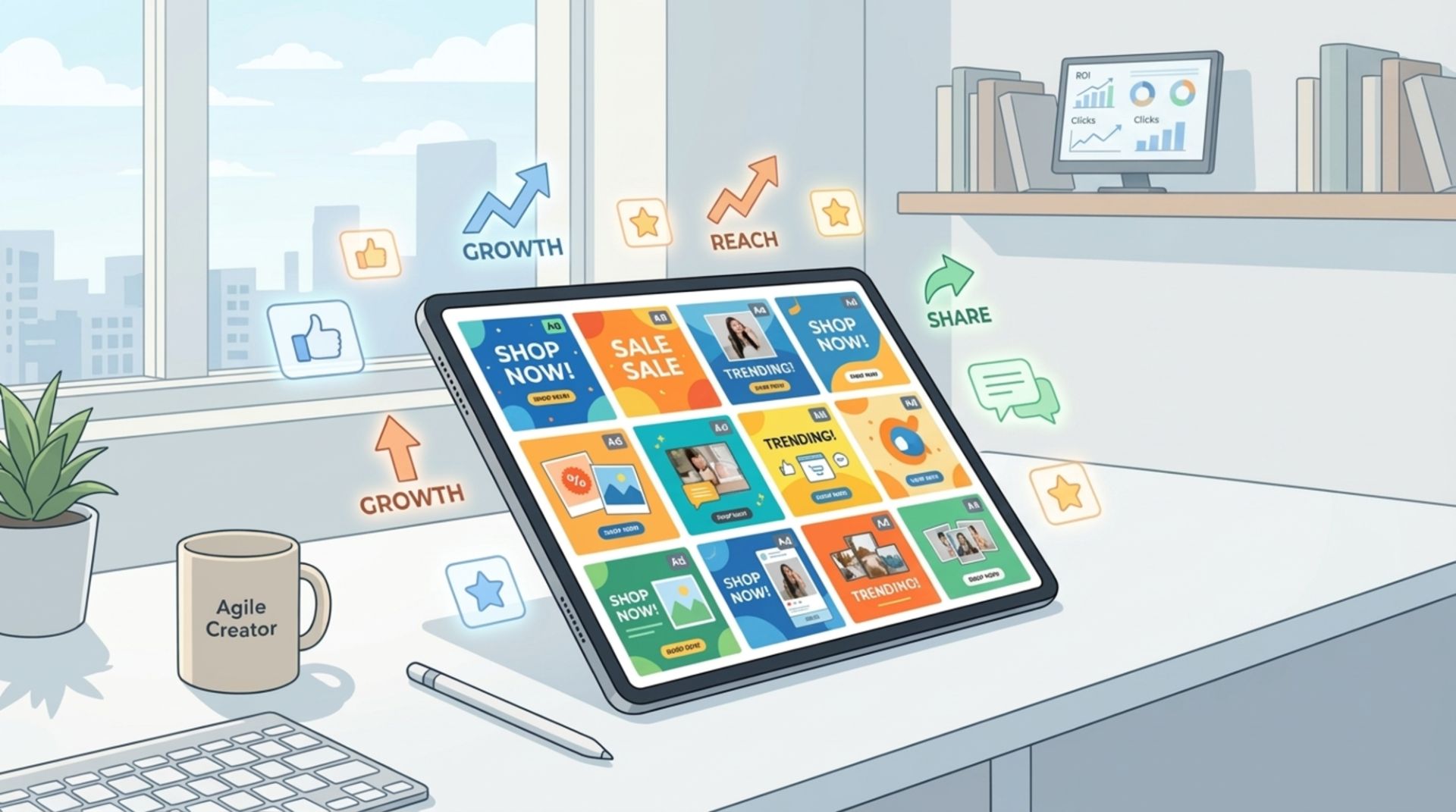
Deep Dive: Where Creative Facebook Ads Outshine Traditional Product Shoots
This is the “self-serve to team expansion” path: a founder or lean marketer starts with a simple system, proves lift through faster iteration, then adds volume and governance (brand consistency, naming conventions, testing logs) as spend increases.
1) Time-to-first-value is measured in minutes, not calendars
With design-led creative facebook ads, your first value is “new angles live” rather than “new photos delivered.” In practice, you can go from brief to first runnable creative within a single working session if you have:
One offer (discount, bundle, free shipping, trial, etc.)
One audience belief to challenge (e.g., “memory foam sleeps hot”)
Three proof points (reviews, warranty, materials, certifications)
Then you generate variations by changing only one variable at a time (headline, primary image, proof module, CTA styling). If you already have a template system, this becomes a repeatable weekly cadence. If you do not, start with a small set of reusable layouts; a good reference for building those is this guide to social media post design systems.
2) More testable angles per SKU without reshoots
Traditional shoots excel at “new reality”: new product colors, new packaging, new lifestyle contexts. But many winning ads are actually message redesigns layered on existing assets. Design-led creative lets you ship variations like:
Problem-first: “Waking up sore?” + annotated feature callouts
Proof-first: “10-year warranty” + review snippet + rating lockup
Offer-first: bundle math, strike-through pricing, urgency modules
Comparison: “Ours vs typical” table tile (compliance-friendly, readable)
Each of these can be produced from the same baseline product renders and customer reviews, then iterated rapidly.
3) Creative governance becomes easier as the team grows
The hidden cost in scaling paid social is not just production; it is keeping output consistent while multiple people ship assets. A design-led approach forces you to define constraints (type scale, spacing, brand palette, icon library, disclaimer rules). That system becomes your “creative API.”
If you need a practical system for producing and reviewing ads consistently, this framework on creative ads design is a useful baseline.
4) Lower reliance on large production crews (with clear limitations)
AI-assisted workflows can reduce the need for constant new shoots for certain categories, especially when the goal is “new layout + new angle,” not photorealistic new scenes. The limitation: for texture-critical products (apparel fabric drape, cosmetics shade matching) and strict retail requirements, you still need real photography.
Where Tetta Space fits (example, not the only option): teams that want campaign-ready visuals quickly often use a studio partner that can scope work fast and deliver editable files for iteration. Tetta Space positions its process around fast turnaround and producing multiple ad formats and variations without a full in-house studio.
When Should You Choose Traditional Product Shoots?
For credibility, here are scenarios where traditional shoots can be the better choice:
You need new truth, not new messaging: new product line, new packaging, new colorways, or major material updates.
Your category demands accurate representation: cosmetics shades, apparel fit/drape, food textures, or regulated claims where visuals must match reality tightly.
A useful hybrid is: do 1-2 cornerstone shoots per year to refresh core assets, then run design-led creative facebook ads cycles weekly using those assets for volume testing.
The Migration Playbook
If you are currently “shoot-dependent,” switching to a creative-first iteration model is mainly an operational change. Use this 3-step migration that minimizes disruption.
Inventory what you already have (60 minutes): collect product photos/renders, UGC, reviews, brand fonts/colors, prior winners, and offer history. Output: one folder per SKU and one doc with top 5 proof points.
Build a small variation engine (1-2 days): create 6-10 reusable ad layouts (statics) across 1:1, 4:5, 9:16. Lock rules: safe zones, max headline length, disclaimer placement. Output: templates your team can duplicate.
Run a controlled 2-week creative sprint: ship 10-20 new variations where each ad changes only one variable. Track results per “angle” not per asset. Output: a clear list of angles worth scaling and angles to drop.
If you want a broader methodology for planning and evaluating creative beyond just layouts, use this guide on creative for digital marketing to structure your hypotheses and measurement.
Decision Matrix + Expert Insight
Decision matrix (choose based on your constraints)
Choose creative facebook ads (design-led iteration) if:
You need more weekly volume (new angles, new offers, new layouts) without scheduling production.
Your performance is sensitive to creative fatigue and you want faster refresh cycles.
You can win by reframing proof, offer, and objections using existing assets.
Choose traditional product shoots if:
You are missing foundational, accurate product photography for your PDPs and ads.
Your product requires high-fidelity visuals (shade accuracy, fabric drape, close-ups).
You need a small set of hero assets for retail, PR, or wholesale requirements.
Expert insight: evaluate beyond the pricing page
When comparing creative production options, ask for these three specifics up front:
Output definition: What counts as one “deliverable”? One square image, or a full set across placements plus variants?
Editable source files: Will you receive organized Figma/Canva sources so your team can iterate without restarting?
Throughput constraints: What is the real weekly capacity (number of variations shipped), and what is the feedback loop time?
This prevents the common trap of “cheap per-asset” that becomes expensive once you need 30-50 iterations.
FAQs
How many variations should I ship per week for creative facebook ads?
For most e-commerce accounts, start with 10-20 meaningful variations per week (not just color swaps). A “meaningful variation” changes one persuasive element: hook, proof, offer framing, objection handling, or format (static vs short video). Scale volume only after you have a clean naming and tracking system.
What is a practical way to measure cost-per-output?
Use: (total production cost) / (number of publish-ready variants across placements). Exclude drafts, rejected concepts, and assets missing required sizes. Track separately for (a) net-new concepts and (b) template-based variations.
Can I rely on design-led ads if I do not have UGC?
Yes. Many strong statics are built from product renders, review snippets, guarantees, and comparison modules. UGC helps, but the bigger lever is a repeatable system that turns your proof points into multiple angles.
Do traditional product shoots still matter for Meta ads?
Yes, especially for new product launches and categories where realism sells. The practical pattern is hybrid: invest in periodic shoots to refresh core assets, then use a design-led iteration engine to multiply angles and formats between shoots.
If you want to increase output of creative facebook ads without adding a full in-house studio, consider working with a partner that can deliver campaign-ready variations fast and in editable formats. Tetta Space is one option for e-commerce teams that want on-brand ad creatives with quick turnaround; share your next campaign brief and request a scoped quote within 24 hours.

Written by Celina Tran
I write about the space where design meets e-commerce. At TETTA, I work with brands to build social templates, scroll-stopping ads, and mascots people remember. Here, I share practical tips on visual consistency and creative workflows, and on how small teams can look big without an in-house design department.

Creative Advertising Design at Scale: Hire, or Subscribe?
Compare creative advertising design via in-house teams vs studio subscriptions. See setup time, scalability, cost-per-output, and a 3-step switch plan.

Creative Ads Design, A Practical System for Making Ads People Actually Notice
Learn creative ads design with a simple system: stronger hooks, clearer layouts, and faster testing. Includes checklists and examples.