
Creative Advertising Design at Scale: Hire, or Subscribe?

Creative advertising design breaks down in the same place for most high-volume teams: you can either build an internal machine (hire, manage, QA) or buy a production engine (subscription studio) that outputs ready-to-run variations. If you are shipping weekly campaigns and testing creatives continuously, the right choice comes down to time-to-first-usable-asset, throughput, and cost-per-output.
Table of Contents
Key Takeaways
Pick the model that minimizes time-to-first-value: the first set of launch-ready ads, not the first meeting.
For creative advertising design at scale, cost-per-output is driven more by review cycles and rework than by hourly rates.
A lightweight 3-step migration (asset audit, system rules, pilot sprint) reduces risk without pausing campaigns.
The State of the Market (Direct Answer)
The primary difference is operational: in-house teams optimize for deep product context and tight cross-functional loops, while studio subscriptions optimize for fast throughput and repeatable production. In-house remains popular, but the market is shifting toward self-serve, modular creative systems and AI-assisted production that lets lean teams generate more variants without growing headcount.
In practice, “better” depends on whether you are bottlenecked by (1) hiring and management overhead or (2) brand nuance and complex stakeholder alignment.
Head-to-Head Comparison Table
Use this table as a first-pass filter. Then validate with a 1-week pilot (details below) using the exact channels and formats you run today.
Criteria | In-House Creative Team | Studio Subscription (External Production Partner) |
|---|---|---|
Setup Time | Weeks to months (hiring, onboarding, process) | Typically days once brand inputs are shared |
Learning Curve | Lower after onboarding, but depends on documenting systems | Low for requesters if briefs and review rules are standardized |
Scalability | Stepwise (hire more designers, add PM, add QA) | Smoother for burst capacity and seasonal spikes |
Integration Ecosystem | Strong internal integrations (Slack, Jira, product teams) | Varies; best partners deliver in your tools (Figma/Canva) and naming conventions |
Cost-per-Output | Often higher at low volume; improves at steady high volume (but includes management + idle time) | Often more predictable; efficient when you need many variations and formats |
Deep Dive: Where a Studio Subscription Outshines In-House
This section focuses on the “self-serve to team expansion” path: you start by removing the creative bottleneck for paid social, then you formalize a system that multiple stakeholders can request against without derailing quality.
1) Time-to-first-value: optimize for the first usable ad set
For creative advertising design, the most practical definition of value is “assets that can go live in your ad account in the right sizes with messaging intact.” In-house teams can be excellent here after onboarding, but time-to-first-value is often delayed by recruiting, onboarding, and agreeing on standards.
Benchmark what matters with a simple SLA you can measure:
Brief to first concepts (hours/days)
First concepts to launch-ready exports (rounds)
Percent of assets needing rework after trafficking (QA misses)
One concrete market signal: some studios explicitly scope projects in under 24 hours and run rapid turnarounds for campaign assets. If you are currently losing a full week to internal scheduling alone, that gap is often the biggest lever.
2) Throughput without brand drift: system beats heroics
High-volume teams do not fail because designers are slow; they fail because every request is a one-off. A studio subscription is strongest when it forces (or reinforces) a repeatable system:
Template primitives: typography, spacing, product framing, offer blocks, disclaimer zones.
Variant rules: what can change (headline, offer, background, hook) vs what cannot (logo lockup, color constraints).
Export discipline: size matrix, naming conventions, versioning, and editable source files.
If you are building this internally, pair this article with social media post design principles, because the same template logic that keeps feeds consistent also keeps ad iterations fast.
3) Cost-per-output: measure the hidden multipliers
Teams commonly compare “designer cost vs studio cost” and miss the multiplier: rework. Use this simple cost-per-output formula for a two-week window:
Total labor cost = design time + PM time + stakeholder review time (estimate hours x loaded rates).
Waste factor = assets not shipped + assets shipped but reworked post-QA.
Cost-per-output = Total labor cost / (Launch-ready assets actually shipped).
When you track it honestly, the most expensive ads are not “high craft” ads; they are the ones that bounce between stakeholders because there is no agreed system for creative advertising design.
4) What “self-serve” looks like in practice
Self-serve does not mean “anyone can design.” It means anyone can request and review without ambiguity. The operational checklist:
Brief template with 6 required fields: objective, offer, audience, hook angle, mandatory elements, placements.
One reviewer accountable for brand and claims compliance.
One source of truth for editable files (commonly Figma or Canva) and a naming convention.
For a deeper breakdown of how to structure ad variations without inflating production, see creative ads design.

When Should You Choose In-House?
Studio subscriptions are not a universal upgrade. Choose in-house when your constraints favor embedded context and real-time collaboration more than speed or burst capacity.
You have complex product education (multi-step onboarding, technical claims, regulated categories) where designers must sit with product and legal daily.
You need constant cross-functional iteration with product marketing, lifecycle, and brand, and decisions happen in live working sessions.
Also note a trade-off: in-house can produce a tighter long-term brand feel when you have senior creative direction and strong documentation. Without that, internal teams can still drift; the drift just happens quietly.
The Migration Playbook
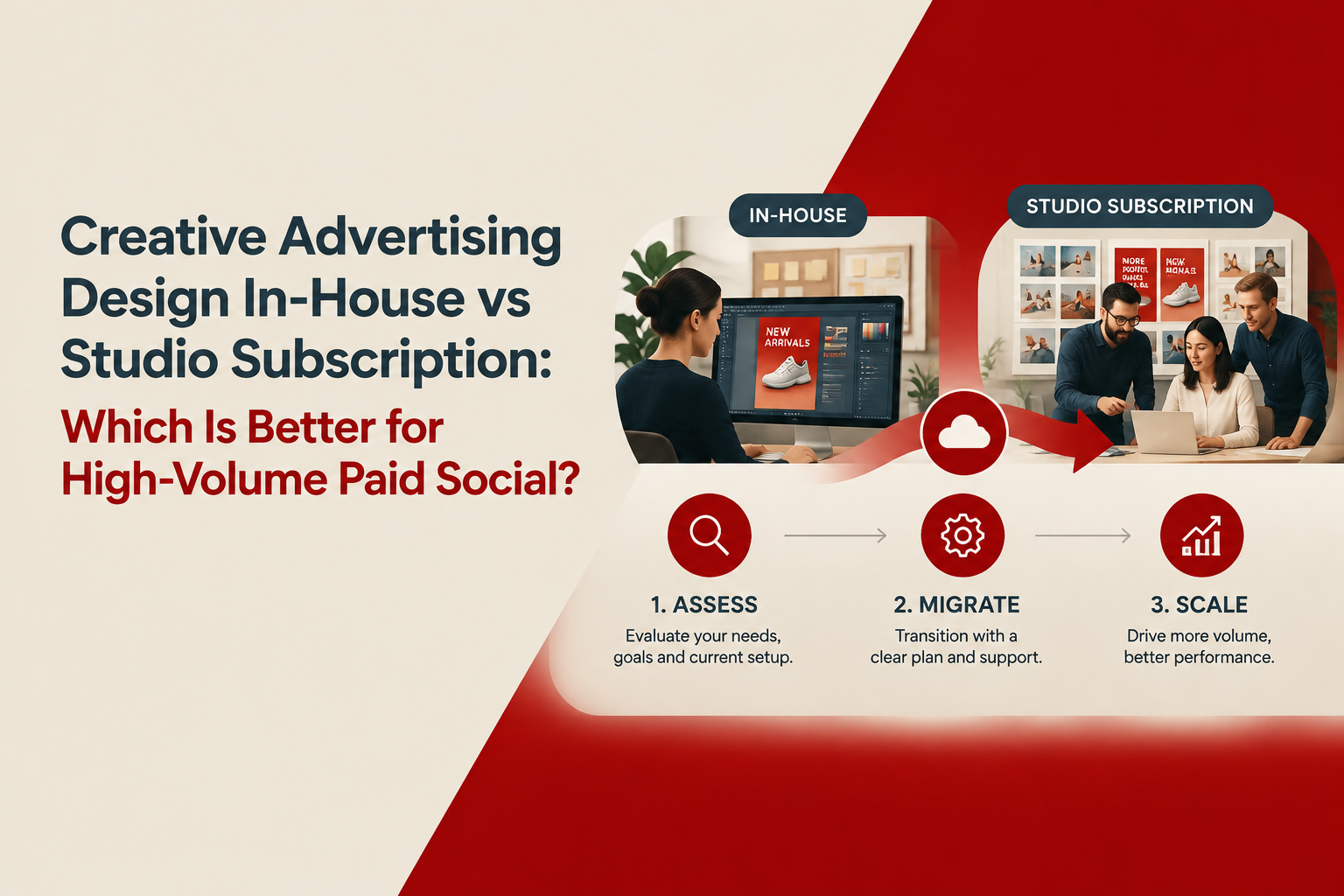
If you are switching from in-house-only to a studio subscription (or adding one), the goal is to integrate without interrupting campaigns. Here is a 3-step process that works in real teams:
Audit and classify your last 30 ads (60 minutes)
Tag each ad by format (UGC-style static, promo, product grid, founder quote, etc.).
Mark which ones were fast wins vs rework-heavy.
Pick 3 “families” to systemize first (the ones you repeat monthly).
Codify your creative system (half-day)
Create 8 to 12 rules: logo placement, type scale, CTA style, claim rules, safe zones, do-not-use patterns.
Share 10 reference ads: 5 “do more like this,” 5 “avoid this.”
Decide your file standard: editable sources plus exports.
Run a 1-week pilot sprint (lowest risk)
Request 10 to 20 variants from 2 winning concepts (not 20 unrelated one-offs).
Measure: brief-to-concept time, rounds to approval, QA issues, and creative testing velocity.
Only then expand scope to more campaigns and channels.
Decision Matrix + Expert Insight
Choose a Studio Subscription if
You need more variants per week than your current team can ship without overtime.
Your biggest pain is waiting: queue time, scheduling, or repetitive resizing and formatting.
You already have a clear offer cadence (launches, promos, evergreen) and want a repeatable production lane.
Choose In-House if
Your creative advertising design depends on deep product nuance and frequent real-time alignment with product and legal.
You have (or can hire) strong creative direction and want that direction embedded daily.
Your volume is steady and predictable enough that internal utilization stays high.
Expert Insight: How to Evaluate Beyond the Pricing Page
Before you decide, run an “operational due diligence” check. Ask for (or document) these specifics:
Revision policy and review loop: What counts as a revision, and who consolidates feedback?
Source-of-truth files: Do you receive editable files and a component system, or only exports?
Quality controls: Is there a pre-flight checklist for placements (safe zones, text legibility, disclaimers)?
This is where many teams win or lose cost-per-output, even if the monthly price looks similar.
FAQs About Creative Advertising Design
How many ad variations should we produce per winning concept?
A practical starting point is 8 to 15 variations per winning concept: 3 to 5 hook/headline options, 2 to 3 offer framings, and 2 to 3 visual treatments. This keeps testing focused while still giving platforms enough creative diversity.
What is the fastest way to improve creative advertising design without a full rebrand?
Build a small system: 3 layout templates, a fixed type scale, and a consistent product framing rule. Most teams see faster approvals and fewer QA misses because decisions move from taste debates to rule checks.
Should our ads match our website design exactly?
They should feel recognizably connected (type, color, tone), but ads often need a higher-contrast hierarchy and simpler message structure than a site. If your landing pages are underperforming, align the handoff by auditing ecommerce site design elements like trust cues, offer clarity, and page speed.
What deliverables should we require from any creative production partner?
At minimum: placement-ready exports in all required sizes, a clear naming convention, and editable source files (so you can reuse and scale). If you plan to expand into brand characters later, ensure the partner can extend into illustration systems such as a mascot in advertising approach without breaking your existing visual rules.
If you want to operationalize this quickly, Tetta Space is one option for campaign-ready creative production built for e-commerce teams, with rapid scoping (often within 24 hours) and organized editable deliveries. Bring one campaign and your last 10 ads, and request a custom quote to run a one-week pilot sprint and benchmark your time-to-first-value and cost-per-output.

Written by Celina Tran
I write about the space where design meets e-commerce. At TETTA, I work with brands to build social templates, scroll-stopping ads, and mascots people remember. Here, I share practical tips on visual consistency and creative workflows, and on how small teams can look big without an in-house design department.

Creative Facebook Ads vs Traditional Product Shoots: Which Fits Lean E-commerce Teams?
Compare creative facebook ads vs traditional product shoots with a decision table, cost-per-output benchmarks, and a 3-step migration playbook.

Creative Ads Design, A Practical System for Making Ads People Actually Notice
Learn creative ads design with a simple system: stronger hooks, clearer layouts, and faster testing. Includes checklists and examples.