
Mascot in Advertising, A Practical Playbook for Brands That Want Recall, Not Just Reach

A mascot in advertising is not just a cute character, it is a repeatable memory cue you can deploy across ads, packaging, email, and social to make your brand easier to recognize. The problem is that many mascots fail because they are treated like a one-off illustration, not a system that can survive new campaigns, new designers, and new formats.
Table of contents
Key takeaways
A mascot should be built as a system (poses, expressions, rules), not a single artwork.
Use the mascot to carry one job (trust, clarity, mood, or navigation) per placement, not everything at once.
Validate fast with recognition and recall checks, plus creative A/B tests where the mascot changes one variable at a time.
What a Mascot Is Actually Doing in Advertising
Think of a mascot as a shortcut to recognition. Humans process faces and characters quickly, and a recurring character gives your audience something to spot before they read. In practice, a mascot typically does one (or more) of these jobs:
Recognition job: helps people identify your ad as yours in a crowded feed.
Explanation job: points, labels, demonstrates, or reacts to product benefits.
Trust job: signals consistency and stability when your offers change weekly.
Emotion job: sets tone (playful, premium, reassuring) without extra copy.
The failure mode is common: brands commission a character, then treat it like clip-art. It shows up once, looks different the next time, and the audience never learns to associate it with the brand. The fix is to design for reuse under constraints.
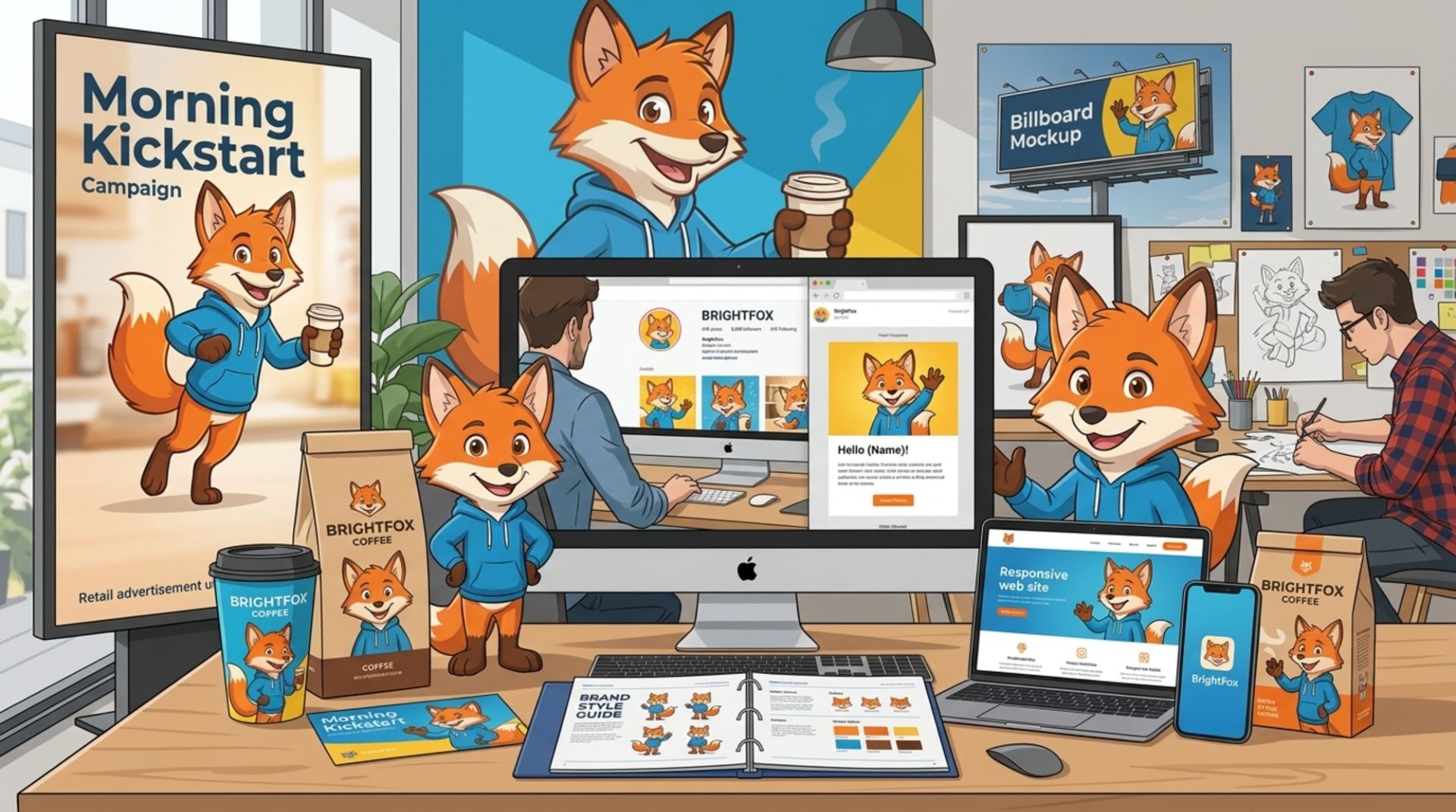
The 4-Part Framework for a Mascot That Performs
Use this framework before you draw anything. Each part includes a pass/fail check so you can align stakeholders quickly.
1) Define the mascot’s single primary role
Pick one primary role for the mascot to own across advertising. Secondary roles are fine, but only after the primary role is clear.
Primary role options: Explainer, Guide, Cheerleader, Protector, Trickster, Expert.
Pass check: In one sentence, you can say: “Our mascot exists to help customers feel/understand ____.”
2) Build “recognition DNA” (3 immutable traits)
Recognition is created by repetition of the same cues. Choose three traits that never change.
Shape cue: silhouette or head shape that still reads at small sizes.
Color cue: 1-2 signature colors that match your brand palette.
Accessory cue: one unique element (hat, badge, tail, glasses, pattern).
Pass check: If you blur the image or shrink it to a tiny icon, the mascot still looks like itself.
3) Design for production, not just aesthetics
A mascot in advertising must survive real constraints: 1:1, 9:16, tiny mobile sizes, fast iterations, and seasonal variants.
Create a pose library: at least 6 poses (pointing, celebrating, holding product, thinking, warning, neutral).
Create an expression library: at least 6 expressions (happy, curious, confident, surprised, skeptical, calm).
Define line/texture rules: stroke weight, shading style, outline usage.
Pass check: A new designer can produce a new mascot visual in 30 minutes using your rules and still match your brand.
4) Decide your “integration level” (how present the mascot should be)
Use this decision table to prevent overuse. Many brands push the mascot into every asset and dilute the message.
Integration level | Best for | How the mascot appears | Main risk |
|---|---|---|---|
Badge | Performance ads that must stay product-first | Small corner stamp, wave, or peek | Too subtle to teach recognition |
Assistant | Explainer ads, carousel steps, landing page sections | Points, labels, reacts to claims | Becomes clutter if copy is long |
Co-star | Brand campaigns, seasonal moments, UGC-style scripts | Shares focus with product | Can steal attention from offer |
Hero | Brand awareness bursts, packaging, merch | Main subject | Low clarity if product is complex |
Mascot in Advertising Placements, Use-Cases With Criteria
Below are concrete placements with “use when” criteria, so you are not guessing.
Paid social ads (static and carousel)
Use when: you run many variations and need a consistent brand cue across changing headlines/offers.
Do: keep mascot size under 10-20% of the canvas unless it is a brand-led campaign.
Avoid: adding the mascot plus extra decorative elements; pick one visual hook.
Short-form video (Reels, TikTok, Shorts)
Use when: you need a recurring “host” to stitch episodes together.
Do: use 2-3 repeatable beats (intro wave, reaction, end-card pose).
Avoid: re-animating from scratch each time; build motion-ready assets once.
Email and lifecycle messaging
Use when: you want friendly nudges for onboarding, shipping updates, winbacks.
Do: pair the mascot with one clear message and one CTA, keep it lightweight.
Avoid: using the mascot to replace clear product photography when the product needs detail.
Website and landing pages
Use when: you need to guide scanning (arrows, callouts) and reduce intimidation for complex products.
Do: treat the mascot as UI support (highlighting benefits, directing attention).
Avoid: putting the mascot in every section; use it at decision points (hero, comparison, FAQs).
If your brand is also rebuilding fundamentals like trust and clarity, pair mascot work with strong ecommerce site design basics so the character supports conversion instead of distracting from it.
A 7-Day Rollout Plan and a Reuse Checklist
Here is a fast plan teams can actually run without stalling campaigns.
7-day rollout plan
Day 1: Role + recognition DNA (primary role, 3 immutable traits, integration level).
Day 2: Style guide page (colors, do/don’t, line rules, minimum size rules).
Day 3: Pose and expression set (6 poses + 6 expressions, exported in common formats).
Day 4: Ad layout tests (apply mascot to 3 existing top-performing ad templates).
Day 5: Social system (add mascot variants into your social media post design templates).
Day 6: Launch a small experiment (see measurement section; keep variables controlled).
Day 7: Document + handoff (folder structure, naming, usage rules, owner).
Reuse checklist (print this)
Consistency: Same 3 recognition DNA traits visible?
Clarity: Mascot supports one message only (points, reacts, or frames), not multiple?
Scale: Works at small sizes and in 9:16 without losing face readability?
Contrast: Mascot does not fight the product photo or headline?
Library: Asset saved back into the master set with tags (pose, emotion, context)?

How to Measure If Your Mascot Is Working
You do not need a complex brand study to learn if a mascot in advertising is helping. Start with simple checks that isolate the mascot’s effect.
Measurement stack (from simplest to stronger)
Internal recognition test (15 minutes): Show 10 mixed ads (some yours, some not) to colleagues outside marketing. Ask: “Which ones feel like our brand?” Track if mascot ads get picked more often. Limitation: internal bias, but useful for fast iteration.
Creative A/B test: Run two ads identical in offer, copy, and format; only change mascot presence (none vs badge vs assistant). Compare thumb-stop proxy metrics and downstream conversion. Limitation: platform learning noise; keep spend and audience stable.
Post-purchase micro-survey: Add one question: “What do you remember most from the ad you clicked?” If the mascot shows up in unprompted responses over time, you are building memory. Limitation: small samples, but directional.
When you are already building a larger system for creative for digital marketing, mascots work best when they are treated like a reusable creative variable: controlled, tested, and iterated like headlines and hooks.
If you want a deeper build process, this guide on how to make a mascot can help you turn the character into a consistent asset library rather than a one-time illustration.
FAQ About Mascots in Advertising
How is a mascot in advertising different from a logo?
A logo is a compact identifier (often static) designed for broad use at many sizes. A mascot is a flexible character system used to express actions and emotions across campaigns. In practice, the mascot often boosts recognition in attention-heavy placements (feeds, video), while the logo anchors the brand in corners, end-cards, and packaging.
Should a mascot always appear in every ad?
No. Use the integration level decision table: badge for performance-first ads, assistant for explainers, co-star for brand moments, hero for awareness bursts. If the mascot reduces clarity of the product or offer, scale it down or remove it for that placement.
Do mascots work for serious or premium brands?
They can, if the style matches the brand. Premium mascots tend to be minimal, restrained in expression, and used more like a guide than a comedian. The pass check is whether the mascot improves clarity or recognition without shifting your tone into something you would not say in copy.
What deliverables should I ask for when commissioning a mascot?
Ask for: a style guide page, a set of core poses and expressions, do/don’t examples, minimum size rules, and well-organized exports (SVG/PNG) plus editable source files. Without these, your mascot will be hard to reuse consistently.
If you want help turning a mascot into a practical ad-ready system (poses, expressions, and launch-ready assets), Tetta Space can design a mascot kit your team can reuse across campaigns. Bring one recent ad and your brand guidelines, and send a brief to Tetta Space to get a clear scope for a mascot rollout.

Written by Thomas D
Hi, I'm Thanh Duong, but most clients know me as Thomas. I lead product design at Tetta Creative Studio, and over the past five years I've designed websites, online stores and digital products for brands in technology, AI, fashion, F&B and beauty, across Vietnam, the US and Australia,... My work sits where user experience meets business results. I map customer journeys, simplify checkout flows and build design systems that help small teams ship faster. On Upwork, I hold Top Rated status, a badge I earned through consistent client satisfaction and on-time delivery. On the Tetta blog, I write about e-commerce UX, product page design, and the practical decisions behind interfaces that convert. When I'm not designing, I'm drawing or playing with my cat. Expertise: UI/UX design, e-commerce product design, design systems, prototyping

How to Make a Mascot People Remember (Not Just Like)
Learn how to make a mascot with a clear step-by-step process, style choices, and a launch checklist so your character stays consistent everywhere.

Ads Design Studio vs In-House Design Team: Which Is Better for High-Tempo Paid Social?
Compare an ads design studio vs in-house design for speed, scale, and cost-per-output. A decision guide for teams shipping paid social weekly.


Canva vs Figma Social Media Design Templates: Which Works Better When Your Team Scales?
Compare social media design templates in Canva vs Figma across setup, scaling, integrations, and cost-per-output so teams choose the right system.