
Ads Creative Studio or In-House: A Practical Shortlist Framework for Paid Social Teams

Choosing an ads creative studio is rarely about taste. It is about throughput, brand consistency, and whether your team can reliably ship enough winning variations each week without turning reviews into a bottleneck. This guide gives you a concrete shortlist framework (with a scorecard and a “trial brief”) so you can evaluate studios quickly and predict performance before you commit.
- Define the job to be done (so you do not buy “pretty”)
- Ads creative studio scorecard: 12 criteria that predict speed and outcomes
- Run a 7-day trial brief (the fastest way to validate fit)
- Common failure modes and how to detect them early
- Decision matrix: studio vs freelancer vs in-house vs subscription
- Implementation checklist: what to prepare before onboarding
- Shortlist an ads creative studio using evidence of process: inputs, review loops, versioning, and delivery formats, not portfolios alone.
- A 7-day “trial brief” with defined deliverables and QA criteria will surface 80% of fit issues before a long contract.
- Use a weighted scorecard to compare options consistently, then back it up with one controlled creative test in your ad account.
Define the job to be done (so you do not buy “pretty”)
Before you compare any ads creative studio, lock down what you actually need produced and how it will be used. The goal is to turn “we need new ads” into a measurable production spec.
Use this 5-line production spec
- Channels and placements: Meta feeds, stories, Reels, TikTok, YouTube Shorts, display, etc.
- Cadence: how many net-new concepts per week, and how many variations per concept (example: 6 concepts x 4 variations).
- Inputs: product photography, UGC, brand guidelines, past winners, landing pages, offer rules.
- Approval flow: who approves, how many rounds, and what counts as “approved” (example: one async round plus one final check).
- Definition of done: exported sizes, editable files, naming conventions, and a delivery deadline tied to launch dates.
If you want a deeper creative system that links messaging to outputs, use this companion framework on creative for digital marketing to align strategy and production.
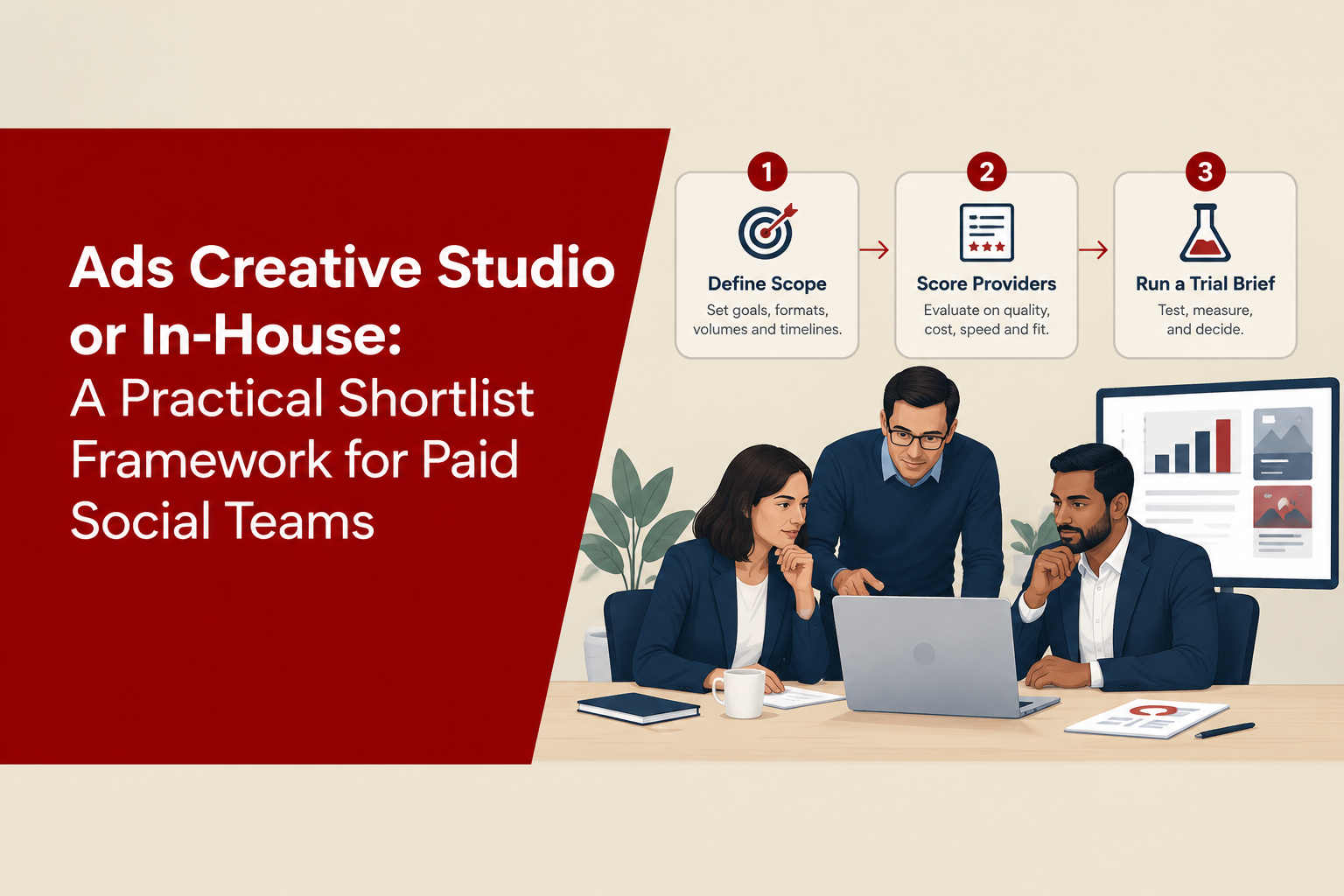
Ads creative studio scorecard: 12 criteria that predict speed and outcomes
Portfolios show style, not reliability. Use a weighted scorecard so every stakeholder evaluates the same things. Score each criterion 1 to 5, then multiply by weight.
Weighted scorecard (copy/paste into a sheet)
- Turnaround time (Weight 15%): Can they commit to predictable delivery windows tied to your calendar?
- Variation quality (10%): Do variations change the hook, layout, offer framing, and CTA, or just colors?
- Brand consistency under volume (10%): Evidence they can scale without drifting.
- Briefing clarity (10%): Do they ask for the right inputs, and do they restate scope clearly?
- Ad format coverage (8%): Static, motion, cutdowns, UGC framing, placement-specific crops.
- Editable files and handoff (8%): Figma/Canva sources, versioning, naming conventions.
- Feedback loop design (8%): How they manage comments, rounds, and approvals.
- Performance awareness (8%): Do they design for readability, thumb-stop, and offer clarity?
- Capacity and continuity (8%): Who is on your account, and what happens if someone is out?
- Process documentation (5%): SOPs, QA checklist, creative library management.
- Security and permissions (5%): How they handle assets, logins, and access control.
- Pricing model fit (5%): Per-ad, retainer, subscription, or project-based, matched to your cadence.
Two practical design benchmarks that matter for paid social: (1) ensure legibility at small sizes, and (2) reduce cognitive load. Nielsen Norman Group’s research on how people scan content is a useful reminder to prioritize clear hierarchy over decorative detail.
Ask for artifacts, not promises
- A redacted creative brief they have used before
- A sample delivery folder showing naming conventions and exports
- A screenshot of how feedback is captured (Figma, Notion, Jira, etc.)
Run a 7-day trial brief (the fastest way to validate fit)
The quickest way to evaluate an ads creative studio is a controlled, time-boxed trial that mirrors real work. Here is a trial brief structure that surfaces process, speed, and craft in one week.
The 7-day trial brief template
- Day 0 input pack: brand guidelines, 3 winning ads, 3 losing ads, offer constraints, product page, and 10 raw assets (photos or UGC stills).
- Deliverables (example): 3 concepts x 3 variations each (9 total) for Meta feed + story crops, plus 1 simple motion version of the top concept.
- Mandatory variation rules: each concept must test a different primary hook; each variation must change at least 2 elements (headline + layout, or offer framing + visual).
- QA checklist: safe margins, legible text, consistent fonts/colors, correct pricing/claims, correct logo usage.
- Review rules: one consolidated feedback doc; max 2 rounds; final delivery includes exports + editable sources.
When you evaluate the trial, do not ask “which one is my favorite?” Ask: “Can we run this same loop every week without chaos?” If you need a concrete approach to building systematic outputs, compare your internal workflow to this guide on creative ads design.
Common failure modes and how to detect them early
Most studio relationships fail for operational reasons, not talent. Use these red flags as a pre-mortem during your first calls and trial.
Red flags checklist (with detection questions)
- Portfolio-only selling: Ask “Show me a delivery folder and your naming conventions.” If they cannot, expect messy handoffs.
- Variations that are cosmetic: Ask for 3 variations of one ad and have them explain what hypothesis each tests.
- Unbounded revision loops: Ask “How many rounds are included, and what counts as a scope change?”
- No placement thinking: Ask for story-first layouts and safe-zone handling.
- Weak offer discipline: Ask how they prevent compliance mistakes (prices, claims, disclaimers).
One practical way to pressure-test their thinking is to give them a single product and ask for 5 hooks in 20 minutes. The goal is not brilliance; it is repeatability. If you want to benchmark your expectations against building in-house, this comparison of an ads design studio versus in-house can help you spot hidden workload (briefing, reviews, resizing, version control).
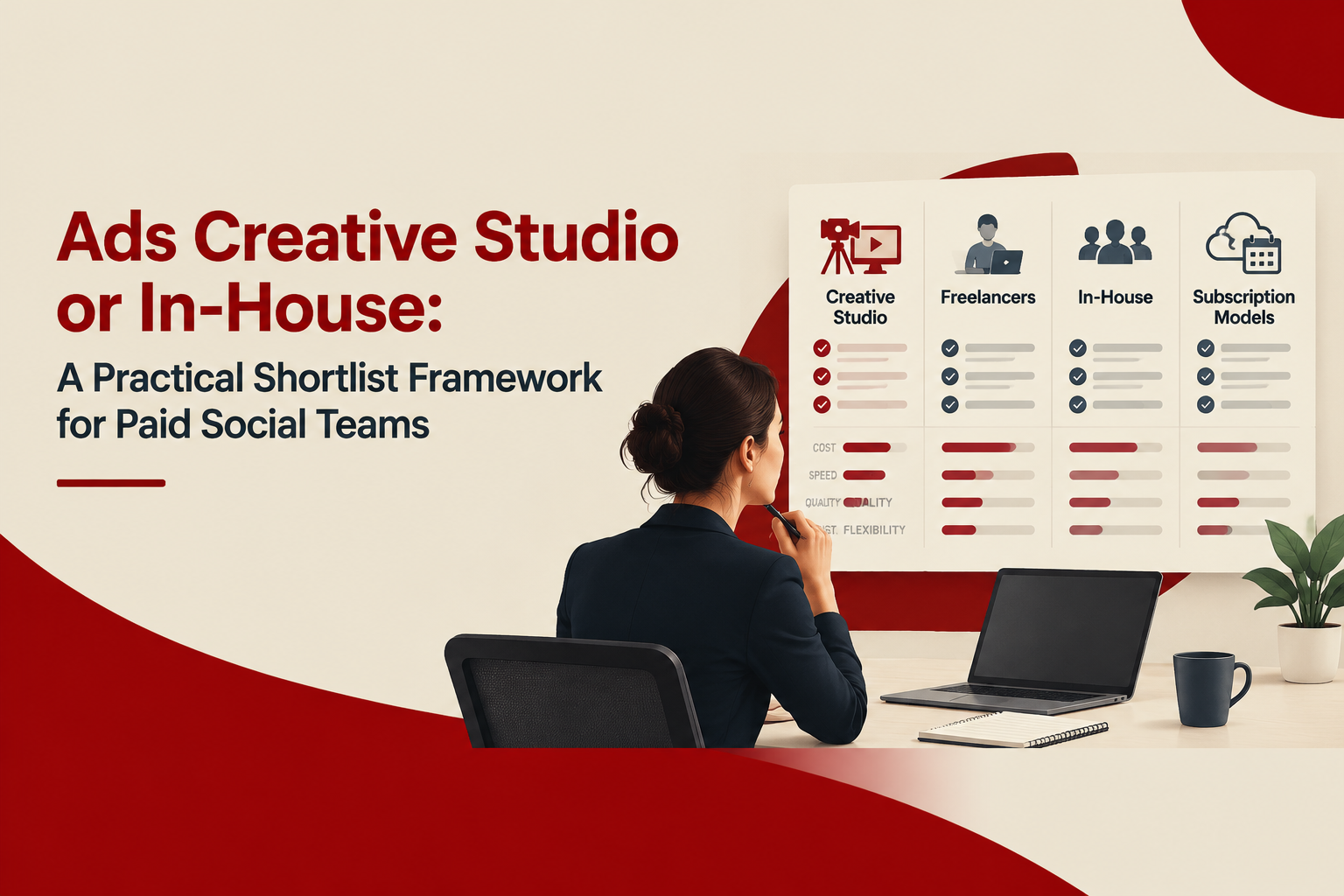
Decision matrix: studio vs freelancer vs in-house vs subscription
Use the table below to shortlist the right model first, then pick a vendor. This prevents you from trying to force an “ads creative studio” to behave like a full internal team (or vice versa).
| Criteria | Ads Creative Studio | Freelancers | In-House | Subscription/Production Partner |
|---|---|---|---|---|
| Best for | Campaign bursts + consistent quality | Specialized tasks or overflow | Deep brand ownership + daily collaboration | Ongoing volume with defined process |
| Speed predictability | Medium to High (depends on process) | Low to Medium | High (if staffed) | High (if scoped well) |
| Brand consistency at scale | High when studio has systems | Variable across individuals | Highest | High when templates and QA exist |
| Management overhead | Medium | High (coordination and QA) | Medium to High (hiring and planning) | Low to Medium |
| Cost shape | Project or retainer | Per asset/hour | Fixed salary + tools | Recurring, often volume-based |
| When it breaks | Unclear approvals, scope creep | Inconsistent availability | Hiring lag, creative fatigue | Mismatched expectations on volume |
If your main constraint is “we need more launch-ready ads weekly,” subscription-style production often wins. If your constraint is “we need tighter strategy and concepting,” you may want a studio with heavier creative direction. For a broader view of scaling creative advertising design, map your model to your testing cadence and team bandwidth.
Implementation checklist: what to prepare before onboarding
Once you pick an ads creative studio, the first two weeks decide whether the relationship compounds or stalls. This checklist prevents the most common onboarding delays.
Onboarding checklist (operational, not theoretical)
- Asset library: logos, fonts, brand colors, product shots, UGC folder, and a “do not use” folder.
- Creative history: last 90 days of winners and losers, with 1 sentence on why you think they performed.
- Offer guardrails: pricing rules, claims policy, required disclaimers, shipping and returns language.
- Format spec: exact sizes and placements required, plus naming convention (example: Brand_Campaign_Hook_VarA_1080x1350).
- Feedback owner: one person consolidates input; no scattered comments across DMs and emails.
- Tooling: choose one feedback surface (e.g., Figma) and one task tracker.
FAQ: Ads Creative Studio Selection
If you want a production partner that can deliver campaign-ready ad creatives with clear scopes and fast turnaround, consider getting a quote from Tetta Space. Share your next campaign goal and required formats, and you can receive a custom scope within 24 hours at tetta.space.

Written by Thomas D
Hi, I'm Thanh Duong, but most clients know me as Thomas. I lead product design at Tetta Creative Studio, and over the past five years I've designed websites, online stores and digital products for brands in technology, AI, fashion, F&B and beauty, across Vietnam, the US and Australia,... My work sits where user experience meets business results. I map customer journeys, simplify checkout flows and build design systems that help small teams ship faster. On Upwork, I hold Top Rated status, a badge I earned through consistent client satisfaction and on-time delivery. On the Tetta blog, I write about e-commerce UX, product page design, and the practical decisions behind interfaces that convert. When I'm not designing, I'm drawing or playing with my cat. Expertise: UI/UX design, e-commerce product design, design systems, prototyping

Ecommerce Layout Design That Guides Shoppers From Landing to Checkout
Learn ecommerce layout design with a practical framework, page-by-page checklist, and examples to improve clarity, trust, and conversions.

Ecommerce Web Layout: Why Shoppers Leave Before They Buy
Learn how ecommerce web layout works, what to prioritize, and a simple framework to improve browsing, trust, and conversion.

18 Data-Backed Insights on Brand Mascot Characters for Ecommerce
Brand mascot characters can lift recall and consistency. See 18 data-backed insights plus a practical rollout checklist for ecommerce teams.
