
Best Business Mascots, Ranked by What Actually Builds Brand Memory

The best business mascots do one job exceptionally well: they make a brand easier to remember at the exact moment a buyer is deciding. But “iconic” is not a design style, it’s an outcome you can evaluate. Below is a criteria-first ranking of well-known mascots so you can borrow what works, avoid what doesn’t, and shortlist the right mascot direction for your own business.
- A mascot is “best” when it is a repeatable system (poses, expressions, contexts), not a one-off illustration.
- Use a scoring rubric: distinct silhouette, role clarity, range, brand fit, and scalability across channels.
- Borrow patterns from top mascots, then validate with quick, buyer-like tests (3-second recall and small-size legibility).
How This Ranking Defines the Best Business Mascots
This isn’t a popularity list. It’s an evaluation based on whether a mascot functions like an asset system that supports recognition across touchpoints (packaging, ads, social, retail, web).
Scoring rubric (5 criteria, 1 to 5)
- Silhouette distinctiveness: recognizable in a 32px circle or from a single-color outline.
- Role clarity: you instantly understand what it “is” in the brand world (guide, hero, proof, humor, authority).
- Range and expressiveness: can it communicate multiple messages without breaking character?
- Brand fit: matches category expectations enough to be trusted, but different enough to stand out.
- Scalability: works across formats (static, motion, packaging, merch, UI), and can be extended into a library.
If you’re actively building brand mascot assets for a growing brand, this rubric helps you compare directions objectively (and defend decisions internally).
Best Business Mascots Ranked (with scores)
These are widely recognized mascots that demonstrate strong “system” thinking, not just good illustration. Scores are relative and meant to be practical benchmarks you can reference in reviews.
| Mascot | Brand | Why it’s memorable (one-liner) | Score (1-25) |
|---|---|---|---|
| Mickey Mouse | Disney | Ultra-distinct silhouette and decades of consistent system use | 25 |
| Ronald McDonald | McDonald’s | Highly codified character world with strong role clarity | 23 |
| Geico Gecko | GEICO | Simple, flexible character that thrives in many ad scripts | 23 |
| Michelin Man (Bibendum) | Michelin | Distinct form tied to product truth, scalable across eras | 22 |
| Pillsbury Doughboy | Pillsbury | Emotion-first mascot with a consistent “feel-good” role | 22 |
| Mr. Peanut | Planters | Clear archetype (gentleman) with strong costume coding | 21 |
| Chester Cheetah | Cheetos | Attitude-driven character voice that stays coherent | 21 |
| Tony the Tiger | Kellogg’s Frosted Flakes | Energy and positivity expressed through repeatable poses | 20 |
How to read the ranking (so it’s useful)
- 25 to 23: best-in-class “system mascots.” They survive new campaigns because the character rules are clear.
- 22 to 20: excellent mascots that rely more on tone and context. Still strong benchmarks for building your own.
Criteria benchmark table (what “good” looks like)
| Criteria | Benchmark to hit | Fast test |
|---|---|---|
| Silhouette | Recognizable without color or texture | Blur test at thumbnail size |
| Role clarity | Viewers can describe it in 5 words | Ask 5 people “Who is this?” |
| Range | 5 to 8 usable emotions/poses | Storyboard 6 common ad messages |
| Brand fit | Feels credible in your category | Place it on a competitor-style shelf mock |
| Scalability | Works in static, motion, and packaging | Mock: ad, email header, box front, sticker |
Limitations: This ranking relies on observable design/system traits and historical usage, not proprietary sales lift data. If you have brand tracker or creative testing results, use those to weight the criteria (for example, put more weight on scalability if you run paid social weekly).
Steal the Strategy: 5 Patterns the Best Business Mascots Share
Instead of copying a character style, copy the underlying mechanics that make the best business mascots work repeatedly.
1) They are built as a library, not a logo replacement
Concrete example: A character that only has “smiling front view” will stall after the first campaign. A character with 3 core poses and 5 expressions can cover dozens of messages.
- Minimum viable library: 1 hero pose, 1 pointing/CTA pose, 1 reaction pose, plus 3 expressions (happy, surprised, concerned).
2) Their silhouette does the heavy lifting
The fastest way to lose recognition is over-detail. The best mascots read instantly, even when platforms compress them.
- Checklist: distinctive head shape, one signature accessory, and a consistent proportion rule (big head/small body, elongated body, etc.).
3) They have a job inside the ad
In mascot in advertising, the character is usually doing one of four jobs:
- Guide: points to benefits, explains steps.
- Proof carrier: holds the product, highlights features.
- Emotion amplifier: makes the before/after feel obvious.
- Attention hook: creates pattern breaks via humor or surprise.
4) They are consistent in “rules,” flexible in “scenes”
Consistency comes from rules (palette, line weight, shading, face geometry). Flexibility comes from scenes (holiday, seasonal promos, new launches). That is why the same mascot can run for years.
5) They show up often enough to earn memory
Mascots are recognition assets. If you cannot commit to repeating the character across campaigns, you will not get the compounding benefit. That is why mascot marketing works best when it’s planned like a system (where it appears, how often, and in what formats).
A Buyer’s Decision Table: Should Your Brand Use a Mascot?
Not every brand needs a character right now. Use this table to decide based on your go-to-market reality, not vibes.
| If you are... | Mascot is a strong fit when... | Mascot is a weak fit when... |
|---|---|---|
| Running frequent paid social | You need fast creative variation with consistent brand cues | You only launch 1 to 2 campaigns per year |
| In a crowded category | Products look similar and you need a distinct memory hook | You already own a unique visual (packaging/icon) with high recall |
| Explaining a new concept | A “guide” character can simplify onboarding and feature education | Your product requires formal authority and low playfulness |
| Building community/merch | You want something fans can share, sticker, or collect | Your buyers dislike branded characters (some enterprise contexts) |
How to Brief and Evaluate a Mascot Concept in 30 Minutes
This is a quick workflow you can run with your team or an external designer. It reduces subjective feedback and helps you get to a mascot that behaves like the best business mascots, not just a nice drawing.
Step 1: Write a one-sentence “job description”
- “Our mascot’s job is to help customers feel ____ when buying ____.”
- Pick one role: guide, proof carrier, emotion amplifier, attention hook.
Step 2: Define 3 non-negotiable constraints
- Must work at 32px (favicon/social avatar scale).
- Must have one signature feature (hat, shape, accessory).
- Must fit inside two backgrounds you use constantly (your primary feed background and your ad background).
Step 3: Require a “system deliverable,” not just a concept
Ask for:
- 1 hero pose
- 1 CTA/pointing pose
- 1 reaction pose
- 3 expressions
- 1 simple motion-ready version (separated layers), if you do video
Step 4: Run two fast tests
- 3-second recall test: show it quickly, hide it, ask what brand it was and what it was “doing.”
- Platform test: drop it into a paid social template and a product page banner. If it fights the layout, you will avoid using it later.
Step 5: Score it (and make the trade-off explicit)
Use the five-point rubric from Section 1. If the team wants a more detailed style, make the trade-off explicit: detail often costs silhouette clarity and speed of production.
FAQ About the Best Business Mascots
If you want a mascot system you can actually deploy across paid social, launches, and seasonal campaigns, Tetta Space can help you go from concept to a usable set of poses and expressions quickly. Review their brand mascot work and request a custom quote so you can ship a character library, not just a character.

Written by Celina Tran
I write about the space where design meets e-commerce. At TETTA, I work with brands to build social templates, scroll-stopping ads, and mascots people remember. Here, I share practical tips on visual consistency and creative workflows, and on how small teams can look big without an in-house design department.
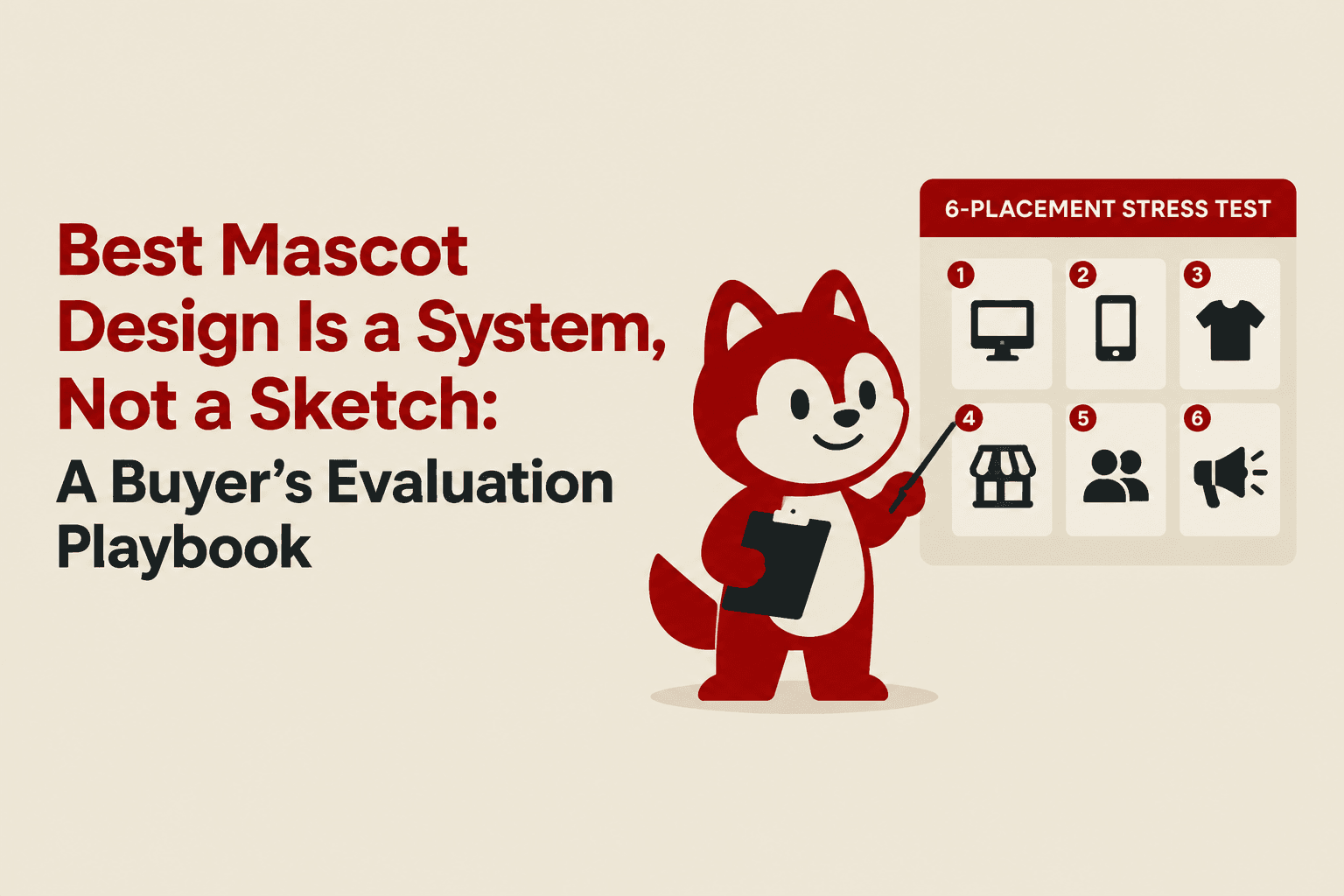
Best Mascot Design Is a System, Not a Sketch: A Buyer’s Evaluation Playbook
Learn how to evaluate best mascot design with clear criteria, a scoring rubric, and deliverables to request before you hire a designer.

Mascot Logo Brand Decisions Made Clear With a Practical Framework
Learn how to build a mascot logo brand with a practical framework for strategy, design, consistency, and memorable customer recognition.

Mascot in Advertising, A Practical Playbook for Brands That Want Recall, Not Just Reach
Learn how to use a mascot in advertising with a practical framework, examples, and a rollout checklist to improve brand recall and consistency.
