
Creative Advertising Campaigns That Actually Convert, A Practical Shortlisting Framework

Most teams do not struggle to generate ideas, they struggle to choose which creative advertising campaigns to ship, in what formats, and how to judge if the concept is strong before spending budget. This post gives you a simple scorecard and a production plan you can use to shortlist campaign directions quickly, then turn the winner into variations for paid social.
- Use a scorecard to judge campaign concepts before you design 30 assets.
- Great creative advertising campaigns balance novelty with proof: claim, reason to believe, and a clear next step.
- One strong concept can produce 12 variations by rotating hook, visual mechanism, and offer framing.
The Real Reason Creative Campaigns Underperform
In practice, most underperforming campaigns fail for one of these measurable reasons, not because the idea was “not creative enough”:
- No single job-to-be-done is dominant. The ad tries to sell comfort, price, sustainability, and durability at once. Result: weak comprehension.
- The claim is not “provable” in-ad. If you cannot show the mechanism, the comparison, or the outcome, people default to skepticism.
- Production constraints silently dictate the concept. The team chooses what is easy to make, not what is likely to win.
- Testing is treated like formatting. Changing colors and headlines is not a test if the core promise stays the same.
If you want more context on how advertising and creativity work together in real performance environments, the main takeaway is simple: creativity has to earn attention and
A 12-Point Scorecard to Evaluate Creative Advertising Campaigns
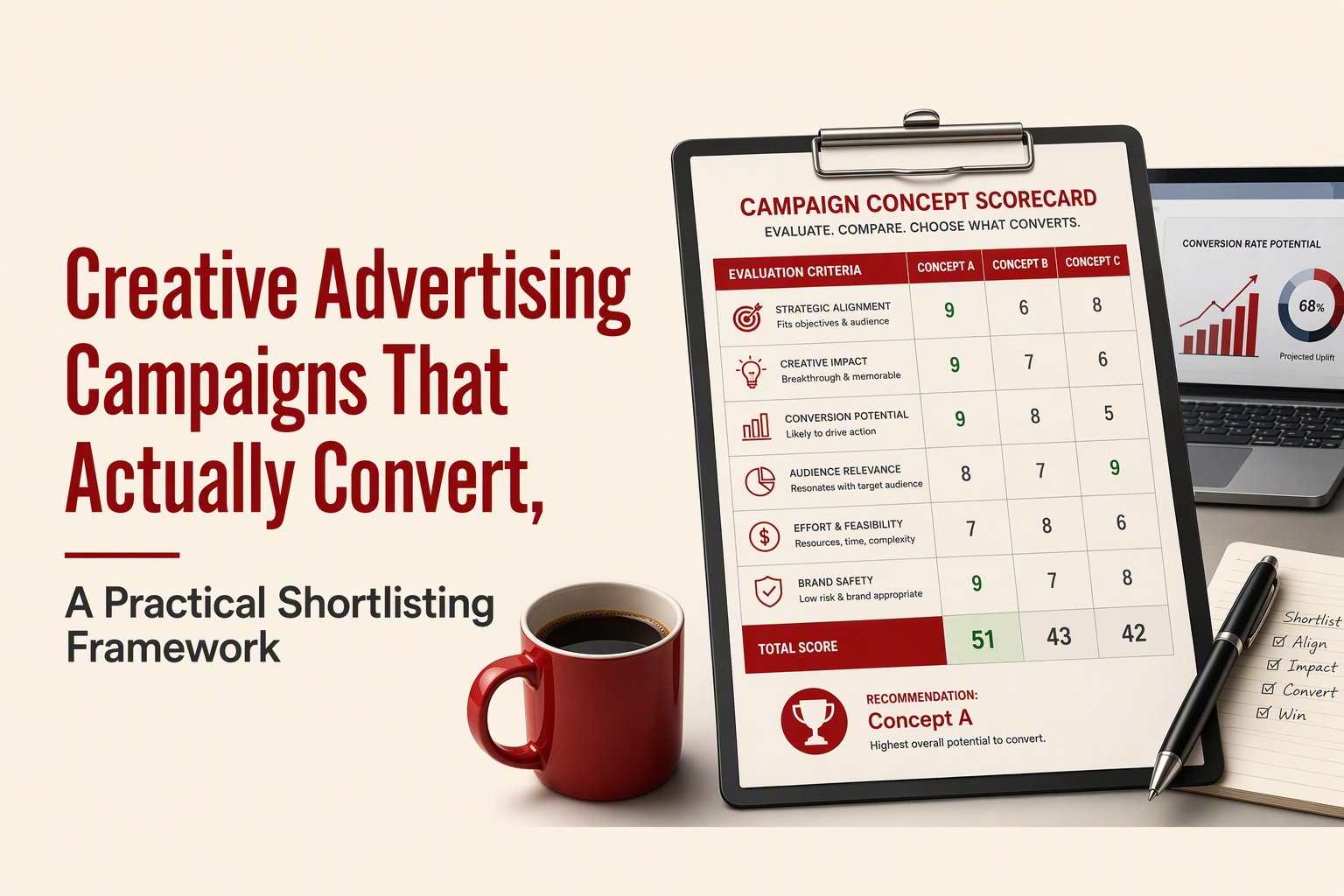
Use this scorecard in a 30-minute review with marketing, design, and whoever owns the P&L. Score each concept 1 to 5 (1 = weak, 5 = strong). Your goal is not to find perfection, it is to identify which concept deserves production time.
Concept clarity (3 checks)
- Single-minded promise: Can you summarize the core claim in 8 words or fewer?
- Immediate context: In the first 2 seconds (or first line), is it obvious what the product is and who it is for?
- Distinct angle: Is the promise different from your last 3 campaigns (not just new visuals)?
Proof and believability (3 checks)
- Reason to believe: Does the ad show a mechanism (how it works), a comparison, a demo, or a measurable result?
- Specificity: Are there concrete details (materials, time saved, steps reduced, ingredients avoided) instead of vague benefits?
- Risk reversal: Is there a warranty, trial, return policy, or “what happens if it does not work” reassurance?
Friction removal (3 checks)
- Objection coverage: Does it answer a top objection (price, fit, setup, durability, safety) without adding complexity?
- Offer coherence: If there is a discount, does it reinforce the concept (not distract from it)?
- Next step clarity: Is the call to action aligned with where the buyer is (shop, compare, bundle, subscribe)?
Production reality (3 checks)
- Asset feasibility: Can you produce the needed formats (9:16, 1:1, 4:5) without reshoots?
- Variation potential: Can you make 6 to 12 meaningful variations without inventing a new concept?
- Brand consistency: Will it still look and feel like you after 10 variations? (If not, you will stop scaling it.)
How to use the score:
- 50 to 60: Produce it now. Build a variation set and launch.
- 38 to 49: Fix the lowest category first (usually proof or clarity), then rescore.
- Under 38: Park it. Do not “save it” with more formats.
A Comparison Table: 3 Common Campaign Routes (and When to Use Each)
When teams say they want “more creative advertising campaigns,” they usually mean one of three routes. Each has a different risk profile and production requirement. Use the table to pick the right route for your next sprint.
| Criteria | Product Proof Campaign | Offer-Led Campaign | World-Building Campaign |
|---|---|---|---|
| Best when | You can demonstrate a mechanism or outcome | You need efficient conversion during a promo window | You need memorability and differentiation in a crowded category |
| Primary creative unit | Demo, comparison, before/after, explanation | Clear deal framing + urgency + SKU clarity | Character, story, recurring visual world |
| Main risk | Too technical or boring if overexplained | Commoditizes brand if repeated too often | High effort, can drift from conversion |
| What “proof” looks like | Steps, close-ups, measurements, tests, reviews | Price anchoring, bundles, shipping/returns clarity | Social proof + product integration into the story |
| How to create 10+ variations | Rotate use cases and objections | Rotate offers, bundles, thresholds | Rotate episodes, formats, and recurring jokes |
| Good first test metric | Hold rate / thumb-stop + click intent | CTR to PDP + add-to-cart rate | Recall proxies (saves, shares) plus assisted conversion |
Implementation note: if your team tends to debate aesthetics, adopt a decision system for creative advertising design so concept selection is not a taste war.
Turn One Campaign Idea Into 12 Testable Ads (Without Losing the Brand)
The fastest way to scale creative advertising campaigns is to treat “variation” as changing one variable at a time. Here is a concrete 3-layer system you can hand to a designer or studio.
Layer 1: Hooks (pick 4)
- Contrarian: “Stop doing X if you want Y.”
- Specific outcome: “Get Y in 10 minutes.”
- Problem spotlight: “If you have Z, this is why.”
- Comparison: “A vs B, the difference you can see.”
Layer 2: Visual mechanisms (pick 3)
- Annotated demo: labels, arrows, step numbers
- Ingredient/material close-up: show the “why” behind quality
- Social proof collage: rated reviews, UGC frames, press snippet
Layer 3: Conversion framings (pick 1)
- Starter offer: first purchase incentive or bundle
- Risk reversal: trial, warranty, returns
- Availability: seasonal drop, limited colorway, shipping cutoff
Math: 4 hooks x 3 mechanisms x 1 framing = 12 ads from one concept, each with a clear hypothesis. This is the kind of creative for digital marketing that improves outcomes because you can learn what variable drove performance.
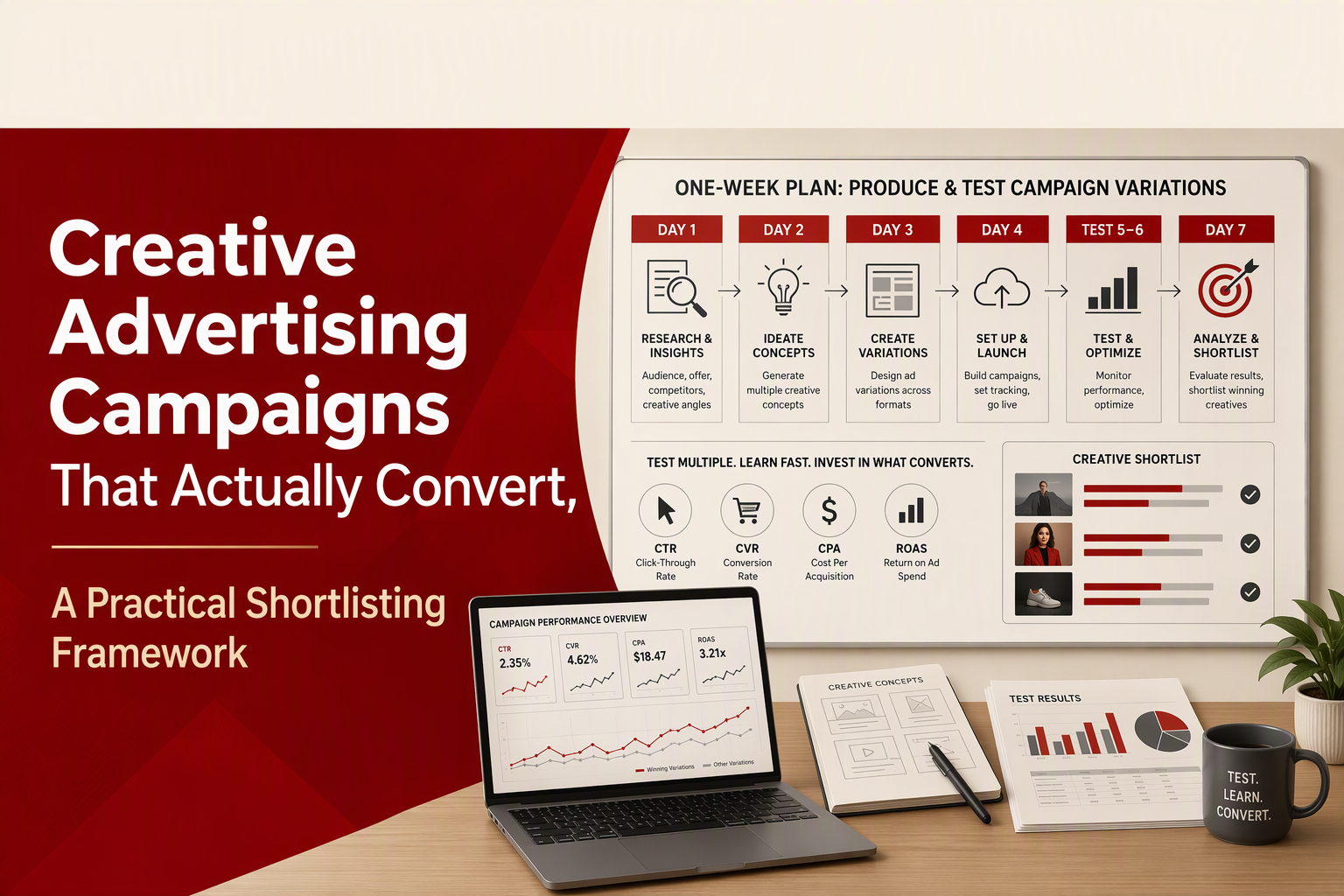
A One-Week Execution Plan You Can Reuse
To move fast without chaos, run your next campaign build as a 5-step checklist. It is designed for teams shipping paid social and landing-page traffic, where speed and consistency matter.
- Day 1: Pick the route + brief the concept
- Choose: product proof vs offer-led vs world-building
- Write the 8-word promise
- List 3 objections to cover
- Collect 5 proof assets (reviews, specs, UGC frames, test results)
- Day 2: Storyboard 12 variations
- Lock 4 hooks and 3 mechanisms
- Define what changes in each ad (and what stays fixed)
- Day 3 to 4: Produce with a brand system
- Use reusable layout rules: typography scale, spacing, CTA treatment
- Keep a consistent visual language so the campaign looks like one idea
- Day 5: QA for clarity and compliance
- 5-second test: can someone explain the product and promise?
- Mobile legibility check: key text readable at arm’s length
- Claim check: can you substantiate what you say?
- Day 6 to 7: Launch + document learnings
- Track results by variable (hook, mechanism), not only by asset
- Promote winners into more formats (carousel, UGC cut, static)
If your bottleneck is production capacity (not ideas), an creative ads design system matters more than another brainstorm.
FAQ About Creative Advertising Campaigns
If you want help turning a scored campaign concept into launch-ready variations quickly, Tetta Space supports e-commerce teams with campaign-ready creative ads and reusable templates. Send your brief and timeline, and you can get a clear scope within 24 hours.

Written by Celina Tran
I write about the space where design meets e-commerce. At TETTA, I work with brands to build social templates, scroll-stopping ads, and mascots people remember. Here, I share practical tips on visual consistency and creative workflows, and on how small teams can look big without an in-house design department.
Carousel Templates for Instagram: 6 Options Worth Shortlisting (and How to Choose)
Compare carousel templates for instagram across Canva, Figma, Adobe Express, and more. Use a checklist to pick a system your team can scale.

Social Media Post Design That Scales, Build a Template System Your Team Will Actually Use
Learn social media post design with a practical template system, checklists, and examples to create faster, consistent posts across channels.

Brand Mascot Basics for Ecommerce, When It Helps and How to Know It’s Working
Learn what a brand mascot is, when it helps ecommerce design, and a practical checklist to build and measure a brand mascot without guesswork.
